
Many travelers have heard stories of hotel staff entering a room after it has been occupied for several days, even if the guest has a “Do Not Disturb” sign on the door. These visits are often referred to as hotel welfare checks, but there is a lot of confusion about when they happen, why they happen, and whether they are actually common.
In this post, we will talk about what hotel welfare checks are, why some hotels conduct them, whether they are as widespread as the internet suggests, and what travelers can do if they would prefer not to be disturbed during their stay.
What Is a Hotel Welfare Check?
A hotel welfare check is when hotel staff enter or inspect an occupied room to verify that the guest is safe and that the room itself is not presenting a problem.
These hotel welfare checks may serve several purposes:
- Ensuring a guest has not experienced a medical emergency.
- Looking for maintenance issues such as leaks or overflowing sinks.
- Confirming the room has not been abandoned.
- Meeting internal security or safety policies.
Do Hotels Really Perform Welfare Checks?
Let me start by saying that my standard mode of operation when I am staying in a hotel is that I immediately put the do not disturb sign on, and I keep it on the entire time I am there. I also always deadbolt the door when I am in the room. If I do want housekeeping or maintenance to come to my room, I will usually tell the front desk when I am going out and ask them to perform that service while I am out.
Because of this pattern, I have wondered if I would be a prime target for a hotel welfare check. While I don’t often stay in the same hotel for longer than 4-5 days, I have never had a hotel welfare check, in the sense that I have had someone come into my room while I was there to “check on me”.
According to some of the things I’ve read online, hotels will do welfare checks if the do not disturb sign is on for 24-48 hours, which seems insane to me, and also contradicts my personal experience. I cannot imagine that in most hotels, the housekeeping or other hotel staff has the time or energy to do checks that often (if at all).
I have also seen anecdotal data that some hotels started performing these hotel wellness checks or hotel welfare checks after the 2017 Las Vegas shooting, where the gunman had a Do Not Disturb sign on his room for multiple days and used that to stockpile the weapons used in the attack.
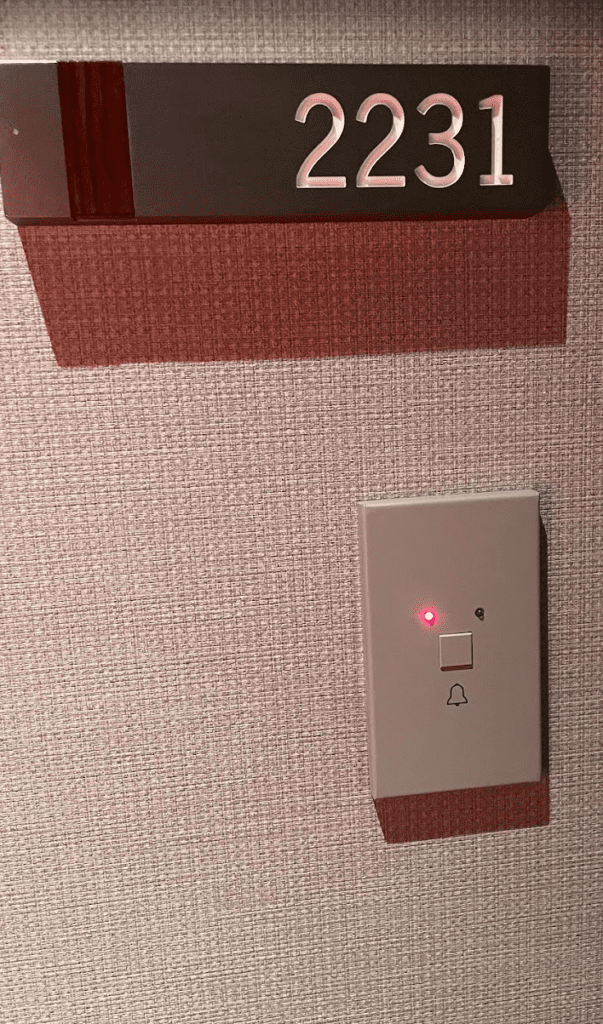
Does Using Your Key Card Prevent a Welfare Check?
Some of the other things that I’ve read online suggest that hotels can track if you have used your key card to access your room, and if you do, that will prevent a hotel welfare check. While I am sure that modern electronic lock systems generally do record key-card activity, I am skeptical that this would affect whether or not a . Hotels can usually see when a room was last accessed by an authorized key because these logs are primarily used for security investigations and lock audits.
From what I’ve seen, there is little evidence that most hotel property-management systems automatically use key-card activity to cancel scheduled welfare checks. In many hotels, housekeeping and room inspections are driven by housekeeping software, occupancy status, or the number of consecutive days a room has displayed Do Not Disturb, and not by any recent room / door lock activity. From what I have seen, there is little to no publicly available documentation showing that key-card use automatically marks a guest as “active.”
How to Reduce the Chances of a Welfare Check
Some ideas to reduce the chances of a welfare check that may or may not work:
- Tell the front desk at check-in that you prefer privacy and ask about the property’s policy.
- Schedule housekeeping every few days if you’re staying for an extended period.
- Remove the Do Not Disturb sign occasionally if you don’t mind a quick service.
- Respond if hotel staff knock before entering.
- Understand that some hotels simply have mandatory room-entry policies that employees cannot override.
If a hotel has a required inspection policy, there may be no way to completely avoid it.
The Bottom Line
Hotel welfare checks are real, but they are probably less common and less mysterious than you might believe. Some hotels never perform them unless there is a specific concern, while others require staff to enter occupied rooms after a certain number of days as part of their safety or security policies.
Although modern hotels can generally see when your key card has been used, there is little public evidence that simply entering your room resets or cancels a hotel welfare check. If uninterrupted privacy is important to you, your best approach is to ask about the hotel’s policy at check-in and understand that practices vary widely from one property to another.
Have you ever had a hotel welfare check happen to you? Leave your experience in the comments below

This site is part of an affiliate sales network and receives compensation for sending traffic to partner sites, such as thepointsguy.com. This may impact how and where links appear on this site. Responses are not provided or commissioned by the bank advertiser. Some or all of the card offers that appear on the website are from advertisers and that compensation may impact on how and where card products appear on the site. Any opinions expressed in this post are my own, and have not been reviewed, approved, or endorsed by my advertising partners and I do not include all card companies, or all available card offers. Terms apply to American Express benefits and offers and other offers and benefits listed on this page. Enrollment may be required for select American Express benefits and offers. Visit americanexpress.com to learn more. Other links on this page may also pay me a commission - as always, thanks for your support if you use them
User Generated Content Disclosure: Points With a Crew encourages constructive discussions, comments, and questions. Responses are not provided by or commissioned by any bank advertisers. These responses have not been reviewed, approved, or endorsed by the bank advertiser. It is not the responsibility of the bank advertiser to respond to comments.
 Dan Miller travels with his wife and 6 (SIX!) children. He loves to help families travel for free / cheap, especially larger families. If you are looking for help, drop him an email at
Recent Comments